Lentils.
Lens culinaris.
The legume that needs no soaking. From the pottage for which Esau sold his birthright to the black Beluga sold as the legume world's caviar. 8,000 years, four colors, and an $8 billion market.
History and Origin of the Lentil
In 2003, archaeologists excavating the village of Ain Ghazal in Jordan found lentil remains dated to 8,000 BCE. At Çayönü in Turkey, lentils from 8,500 BCE were found. This makes the lentil one of the first legumes to be cultivated, together with chickpeas and peas, before humans knew how to write. The Fertile Crescent, the strip of land connecting Egypt through Israel to Persia, is its first home.
The Bible tells of Esau, who sold his birthright to Jacob for a pottage of lentils. The story takes on new meaning when one realizes that red lentils, cooked into a thick, dark-red mash, were probably a cheap everyday food. The birthright, a legal-religious concept of enormous value, was sold for "a worker's portion." The lentil economy was so widespread that a simple pottage was considered the vital minimum.
In Rome lentils were military food. Roman legions carried dried lentils as a commodity well suited to quick preparation. The Roman road network, the Via Appia and its sisters, carried not only soldiers but also sacks of lentils from Egypt to Rome. Roman Egypt was the empire's great lentil supplier.
Lentils are the only legume that does not require soaking before cooking. The reason: a relatively thin skin and a small grain that allows rapid water penetration. 20–30 minutes of cooking for red lentils. 30–40 minutes for green and black. For chickpeas and beans: 60–120 minutes after soaking. Lentils are the fast solution for plant protein.
Leading Lentil Varieties: Red, Green, Black and French
The lentil does not grow as a single variety. There are four main colors in the market, and each developed for a completely different use. Red split for dal and soups, green for salads and stews that hold their shape, black for premium, and French for chef cooking. The difference between them is geography, genetics and what people wanted to cook.
A green-brown lentil that has been hulled and split, exposing the orange-red interior. Cooks to a thick mash in 20 minutes. The base of classic Indian dal and Arab lentil soups. Canada is the world's largest exporter, with Saskatchewan fields producing most of the export to Asia and the Middle East.
The whole grain, with skin. Cooks for 30–40 minutes, retaining texture and not turning to mash. Perfect for salads, stews, and mejadra where whole grains are wanted. The classic variety from France, Spain, Australia and Canada. More uniform than the red split in visual texture.
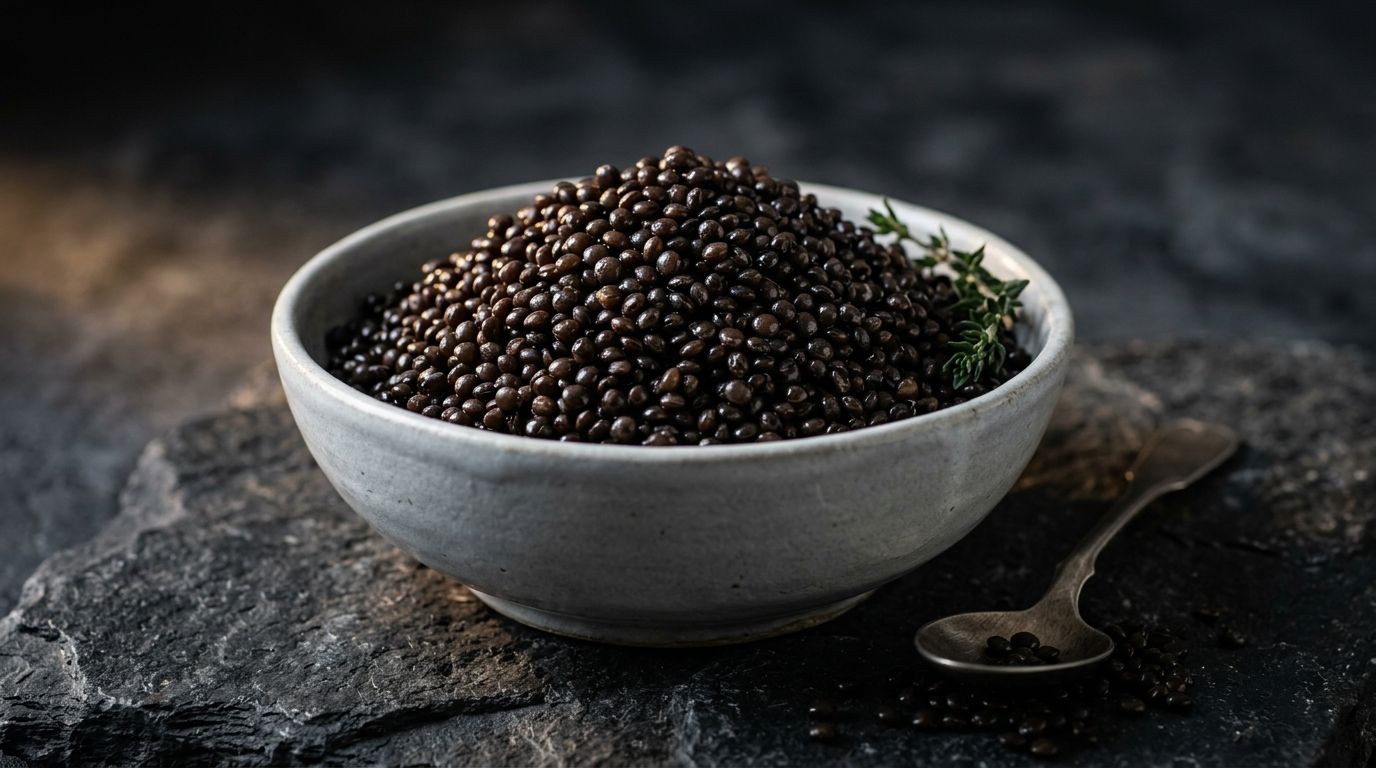
Called Beluga because they look like caviar. A small, glossy-black grain with a firm texture that holds after cooking. A deep nutty flavor. Use: chef cooking, festive salads, plating for gourmet dishes. A price 50–80% higher than the brown. Comes mainly from Canada and Chile.
A bluish-green lentil from a region of extinct volcanoes in south-central France. The unique volcanic soil gives it a peppery-earthy flavor unattainable anywhere else. Michelin three-star chefs will pay a premium price 3–4 times that of the ordinary brown. Protected by European law to the growing region alone.
Cooking the Lentil: Times and Methods
Lentils are the most forgiving legume. Forgot to soak? No problem. Have 20 minutes? Enough for the red ones. The rest are half an hour. Not like chickpeas that require planning ahead, and not like beans that punish every shortcut. This simplicity made them the food of armies, of monasteries, of villages that knew no refrigerator.
Cooking Times by Variety
Industrial Processing
In the commercial market, lentils are sorted by diameter (2–9 mm), color, and integrity. Skins and cracks lower the grade. Red split lentils undergo an additional process: hulling the green-brown skin and cutting in half, exposing the red-orange interior. Lentil flour is produced by fine milling and used for pasta, bread and gluten-free products.
Dried lentils: 2–3 years in proper conditions. Dry, cold, dark, sealed. One disadvantage: after a long year of storage, the cooking time rises significantly. Old lentils take 20 minutes longer. Cooked lentils, frozen: 6 months with no change in flavor.
Lentils in Global Cuisines
No food comes from such a large number of cuisines as lentils. India, the Middle East, Ethiopia, France, Spain. Each developed an independent tradition, usually without connection to the others. This is no coincidence: lentils are cheap, fast and filling. They are the economic common denominator of nearly every civilization that relied on land crops.
Red split lentils with turmeric, ginger, garlic, fried onion and tomatoes. Finished with tadka: hot ghee with cumin, red chili and fried mustard seeds, poured over the top. Served with basmati rice. The everyday food of hundreds of millions of families in the Indian subcontinent.
One of the ancient dishes of the Levant. Whole green lentils cooked with rice, seasoned with cumin, and served with deeply caramelized fried onion. In Syria and Lebanon served with labneh. In Jordan with sour cream. In Palestine with tomatoes. Simple, nutritious, and a symbol of Palestinian-Levantine cuisine.
Red lentils with berbere, a spicy Ethiopian spice blend with chili, cumin, coriander, cinnamon and ginger. Served on injera, the spongy sour bread made from teff flour. One of the common fasting dishes in the Ethiopian Orthodox Church, which has a hundred meat-free fast days a year.
Puy with blended sausages, root vegetables, brandy, and bay leaves. The classic version from the Auvergne. The chef version adds a sweet-sour vinaigrette and serves it with smoked fish. The dish that proved lentils could be luxurious.
"Lentils, the meat of the poor" — a medieval proverb. But on 2024 Michelin menus, Puy lentils with duck liver appear at €120 a course. A difference of 800 years.
Global Lentil Market and Trade
The global lentil market reached $8 billion in 2023. Canada, with the endless fields of Saskatchewan, is the world's largest exporter, about 35% of global exports. India grows more, but consumes almost all of it internally. Canada built a lentil industry by design: varietal research, drying infrastructure, and the port of Vancouver as a gateway to Asia.
| Variety | Average price per ton | Main origin | Target market |
|---|---|---|---|
| Red split | $500–700 | Canada, Turkey, Australia | India, Bangladesh, Egypt |
| Green / brown whole | $600–900 | Canada, Australia, USA | Europe, Israel, Middle East |
| Black Beluga | $1,200–1,800 | Canada, Chile | Europe, USA, Japan |
| Puy D.O.P | $3,500–5,000 | France only | Luxury restaurants, EU |
Israel: A Small Market, a Diverse Consumer
Israel imports lentils mainly from Canada and Australia, with an annual volume of 15,000–20,000 tons. Israeli demand: green lentils for the retail market, red for the food industry (soups, spreads), and Beluga for the gourmet market. The trend: rising lentil consumption as part of the plant-protein revolution. Mejadra, once a classic Friday dish, is returning to tables with chef versions.
Blue Star supplies green and red lentils from Canada to the Israeli market. Red split: $550–650 per ton CNF Israel. Whole green: $650–800. Minimum order: 25 tons (half a container). Suppliers: producers from the Saskatchewan region, Canada.
Market trends: lentil pasta grows 35% annually in Europe. Lentil flour for gluten-free baking is in rising demand. Roasted lentil snacks compete with chickpea snacks. Black lentils and Puy are penetrating the home premium market. The fastest-growing market: ready-to-eat lentil products, frozen mejadra, aseptic lentil soups.
Growing Regions: India, Canada, Turkey and Australia
Canada grows mainly for export: Saskatchewan and Alberta, large fields, advanced drying and storage mechanisms. India grows more, but consumes almost all of it. Turkey: a major supplier to Europe and the Middle East.
Quality Standards and Food Safety
Lentils are relatively safe. Two main risks: aflatoxin and moisture.
| Parameter | EU Standard | Israel Standard |
|---|---|---|
| Aflatoxin B1 | ≤ 2 ppb | ≤ 5 ppb |
| Maximum moisture | 14% | 14% |
| Salmonella | Absent/25g | Absent/25g |
| Insects | Absent | Absent |
Storage: 2–3 years in proper conditions. Dry, cold, sealed. Old lentils: longer cooking time. Cooked lentils: refrigerator 3–5 days, freezer 6 months.
If red lentils take 35 minutes to cook instead of 20, they are old. Solution: a cup of boiling water for 10 minutes before the normal cooking. It is not advisable to store beyond two years.
Nutritional Values and Health Benefits
Diabetes: a GI of 21–29, very low. A Canadian Medical Association Journal study (2012) of 121 type 2 diabetics: adding a cup of legumes a day lowered HbA1c by 0.5% and LDL by 5% after 3 months. Red split lentils were the most effective version.
Iron: 7.5 mg per 100 grams, but non-heme iron, with low absorption. Solution: eat with vitamin C (tomato, lemon) which doubles absorption. An Oxford study (2018): consuming legumes 4 times a week lowered the risk of anemia in women by 11%.
The Israeli Lentil Market
Israel imports 15,000–20,000 tons of lentils per year. Mejadra, once a traditional Friday dish, is returning to menus. The Israeli soup industry uses red lentils for frozen and aseptic soups.
| Product | Israel retail price | Origin |
|---|---|---|
| Red split lentils | ₪9–14 per kg | Canada, Turkey |
| Whole green lentils | ₪10–16 per kg | Canada, Australia |
| Black Beluga | ₪22–35 per kg | Canada, Chile |
Future Trends: Lentil Pasta and Plant Protein
The lentil market in 2030: $12 billion. The growth comes from three directions: processed lentil products (pasta, flour, isolate protein), the Beluga premium market, and rising legume consumption as part of the plant-protein revolution.
Lentil pasta: Barilla and De Cecco have released lentil versions. 25% protein, gluten-free. 35% annual growth. Lentil flour: Beluga flour with a deep flavor, used in artisan bread. Beluga at Whole Foods: $12–18 per half kilo, a growing premium market. Blue Star supplies green and red lentils from Canada. Minimum 25 tons. CNF Israel.
A pottage for which a birthright was sold 4,000 years ago. Today sold at Whole Foods for $18 a half kilo. The Beluga made the journey from a poor man's kitchen to a Michelin menu.
Interested in this product?
Send a message directly to Blue Star with the commodity details, and we'll get back to you within an hour during business hours.