Green Peas.
Pisum sativum.
The legume Mendel used to discover the laws of genetics. From 10,000 years of Neolithic cultivation, through Canada's frozen fields, to a pea-protein industry threatening to change what we drink.
Mendel, the Neolithic and 10,000 Years of Cultivation
In 1866, an Augustinian monk named Gregor Mendel published a paper on experiments he conducted in the monastery garden in Brno, Czechia. Seven years, 29,000 pea plants, 14 traits tested. The conclusion: heredity is not a blending of traits but the passing of discrete units. He called them "factors." The "factors" are what we call genes. Mendel laid the foundations of genetics, and until his death in 1884 it was known to no one. His discovery was rediscovered in 1900.
The pea (Pisum sativum) is one of the oldest legumes to be domesticated. Remains were found in Georgia from 9,000 BCE, and at an archaeological site in Syria from 8,000 BCE. The plant grew wild in the Mediterranean and Central Asia, and humans domesticated it with the first crops — wheat, barley and legumes — at the start of the agricultural revolution.
What makes the pea a perfect genetic experiment is its clear dominance and recessiveness: a seed smooth or wrinkled, round or oblong, green or yellow. Clear contrasts that Mendel could count and measure. Wheat, by contrast, with many continuous traits, was very hard to analyze with 19th-century methods.
The pea is a cool-season crop. It grows at 13–18°C, and cannot withstand summer heat. In Israel: a winter crop, ripening from January to April. In Canada: a summer (cool) crop, harvested July–August. Across the world, the complementary seasons allow an almost year-round supply of fresh green peas.
Green, Yellow, Split: The Three Faces of the Pea
Most people think of frozen green peas, but the market recognizes three completely different categories. Green peas (Garden Peas) are picked unripe and intended for fresh eating. Yellow split peas are peas harvested at full maturity, blanched and split, used for stews and soups. And whole dried peas grow to full drying on the stem.
Picked before reaching full maturity, while the grain is still green and sweet. The sugars begin turning to starch within a few hours of harvest, so frozen peas (blanched and frozen within hours of harvest) are often nutritionally fresher than "fresh" peas in the supermarket.
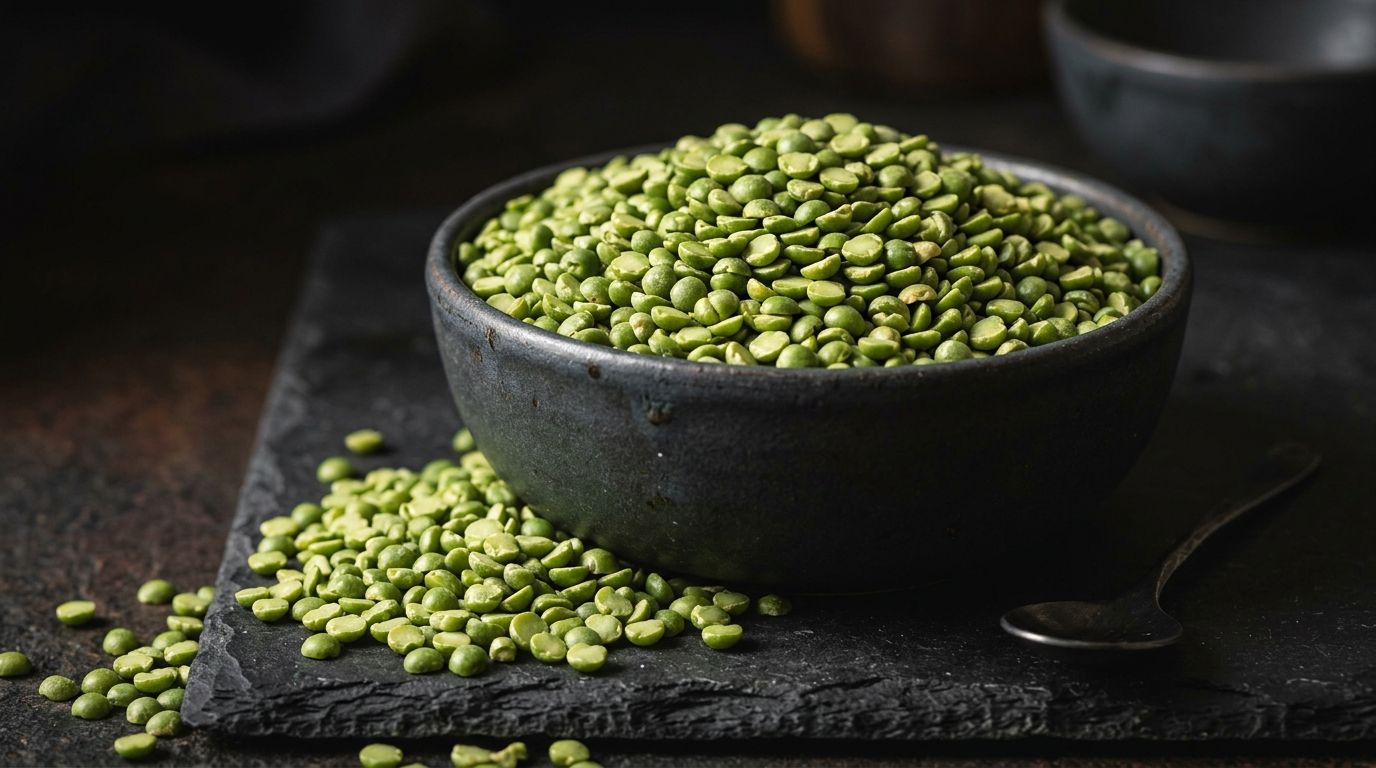
Whole peas that have been hulled and split, exposing the inner side. Cooks to a smooth mash in 20–30 minutes without soaking. The yellow version is milder in flavor, the green more mustardy-herbal. The base of Dutch pea soup (erwtensoep), of Indian pea dal, and of traditional dishes in Scandinavia and Britain.
Peas left on the stem until fully dried. Require 8 hours of soaking and 60–90 minutes of cooking. Hold their shape better than the split form. Used for long stews, for dried-pea salads, and for producing pea flour for the protein industry.
The Pea Protein Revolution: Beyond Meat, Oatly and the Future of Protein
In 2019, Beyond Meat went public on Nasdaq and its value jumped to $4 billion on the first day. The active ingredient: pea protein. Oatly, the Swedish oat milk that conquered the world, adds pea protein to improve the nutritional profile. Good Catch, the plant-based tuna, is built on a pea base. A new industry that grew from $100 million in 2020 to a projected $3 billion in 2030, all coming from an ancient green-yellow grain.
The Production Process of Pea Protein Isolate
Production consists of four main stages. First, milling dried peas into flour. Second, wet separation: the flour is mixed with water and brought to a pH of 4.5, the isoelectric point of pea protein, where the protein precipitates. Third, separation of the starch and fiber that remain in solution. Finally, spray-drying into a white powder. The result: 80–90% protein, compared to 25% in the whole grain.
Soy is a complete protein with a superior profile, but: 90% of American soy is GMO, it has a recognized allergen and growing regulation against it, and awareness around soy and health is rising. Pea, by contrast: non-GMO, not among the 8 major allergens, neutral in flavor, and produced mainly in Canada and Europe, which are less genetically modified. That is why Beyond Meat and others chose it.
Pea Flour: An Industrial and Culinary Product
Pea flour (25% protein, gluten-free) is used for pancakes in India (matar cheela), for tempura coating, for high-protein bread, and for protein pasta. The texture differs from wheat flour: heavier, slightly mustardy, requiring blending. It does not replace wheat one-to-one, but works excellently in 20–30% of the recipe.
Erwtensoep, Mushy Peas and Matar Paneer: Peas Around the World
Cooked dried peas are a classic poverty food that, over time, became national nostalgia. In the Netherlands, yellow pea soup (erwtensoep) is a winter cultural symbol. In Britain, Mushy Peas are part of the national identity as much as Fish and Chips. In India, Matar Paneer is the best-selling vegetarian dish. Three peoples, three approaches, the same grain.
Yellow split peas with root vegetables (celery, leek, carrot), smoked pork and rookworst sausage. A soup so thick that a spoon can stand upright in it. Served with dark rye bread and butter. The Dutch have a saying: "pea soup is better on the second day." A winter tradition of leaving it on a low flame all night.
Whole dried green peas (Marrowfat Peas), soaked and cooked into a green mash with a dark tone. Served hot alongside fried fish and chips. The northern-English version includes mint. In southern England: more beige-green and delicate. Gourmet Mushy Peas are served today in London chef restaurants in a pâté version.
Fresh or frozen green peas with cubes of paneer (Indian fresh cheese) in a tomato-onion stew with garam masala, coriander and ginger. Served with roti or basmati rice. One of the classic "Dhaba" (Indian roadside restaurant) dishes. The dish that proves frozen peas can be almost as good as fresh.
Whole yellow peas with salted pork. In Sweden, Thursday is traditionally pea-soup day. The custom dates back to the Middle Ages, when Friday was a fast day (no meat), so pork was eaten on Thursday. Today, army, school and hospital canteens still serve Ärtsoppa every Thursday.
Mendel counted 29,000 pea grains in his monastery garden to discover genetics. Today, Canada alone exports 4 million tons of peas a year. What was a forgotten experiment became an industry.
Market: Canada Dominates, Pea Protein Grows, $3 Billion on the Way
Canada is the world's largest exporter of dried peas: 4–5 million tons a year, about 40% of global exports. The fields of Saskatchewan and Alberta produce yellow split peas, green split peas and whole peas that ship to India, China, Bangladesh and the Middle East. Canadian pea exports grew 180% between 2010 and 2023.
| Product | Price per ton | Leading origin | Main destination |
|---|---|---|---|
| Yellow split peas | $380–520 | Canada | India, Bangladesh, Pakistan |
| Green split peas | $420–580 | Canada, Australia | Europe, Middle East |
| Frozen green peas | $600–900 | India, Peru, Belgium | Global |
| Pea Protein Isolate | $2,500–4,000 | Canada, France | USA, Europe, Israel |
Israel: A Growing Market
Israel imports dried split peas from Canada and frozen peas from India and Peru. Annual volume: 8,000–12,000 tons. Demand for pea protein is rising with the health-products market. Pea mejadra (a substitute for lentils) appears in some kitchens. The Israeli food industry is beginning to incorporate pea protein into processed foods.
Blue Star supplies yellow split peas from Canada: $420–500 per ton CNF Israel. Green split peas: $480–560. Minimum: 25 tons. Packaging: 25 kg bags. Time: 35–45 days. Pea Protein Isolate on request from Canadian sources.
Trends 2024–2030: pea milk grows 35% annually and threatens oat milk. Pea Protein Isolate enters sports proteins, bars and yogurts. Pea pasta grows 40% annually. Sprouted peas for the gourmet market. The whole market: from $100 million in 2020 to a projected $3 billion in 2030. A legume that was a winter soup became an industry.
Geography: Canada Dominates Exports
Saskatchewan, the Canadian wheat belt, also grows enormous quantities of peas. The cold climate there suits it excellently: a short summer, natural drying in the field. 180% growth in Canadian exports between 2010–2023.
Health: Vitamin K, Protein, and Prebiotic Research
Vitamin K: cooked green peas contain 65 mcg of vitamin K per 100 grams, essential for blood clotting and bone health. Those taking warfarin (Coumadin) should be consistent in their vitamin K intake — not stopping, not increasing.
Prebiotic: Galactooligosaccharides (GOS) from peas feed mainly Bifidobacterium. A Gut Microbiome study (2023): 3 servings of legumes per week increased gut-bacteria diversity by 18% after 8 weeks.
Pea Storage and Safety
| Form | Conditions | Shelf life |
|---|---|---|
| Whole dried peas | Dry, cool, sealed | 3–5 years |
| Split peas | Dry, cool | 2–3 years |
| Frozen peas | Freezer | 12–18 months |
| Cooked peas | Refrigerator | 3–5 days |
Peas contain lectins (Phytohemagglutinin) in a low amount, far less than red kidney beans. Normal cooking (20–30 minutes) neutralizes them completely. Frozen peas have undergone blanching and are safe. Raw peas: do not eat large quantities.
Peas in Israel: Soups, Frozen Dishes and Pea Protein
Israel imports dried split peas from Canada and frozen peas from India and Peru. Annual volume: 8,000–12,000 tons. Demand for pea protein is rising with the health-products market.
| Product | Retail price | Origin |
|---|---|---|
| Yellow split peas | ₪7–11 per kg | Canada |
| Green split peas | ₪8–13 per kg | Canada, Australia |
| Frozen green peas | ₪9–14 per kg | India, Peru |
Yellow split peas from Canada: $420–500 per ton CNF Israel. Green split: $480–560. Minimum: 25 tons. COA: moisture, aflatoxin, Salmonella.
The Future: A $3 Billion Pea Protein Market in 2030
The pea protein market is expected to grow from $100 million (2020) to $3 billion (2030). Beyond Meat, Oatly, Good Catch — all rely on peas as a base protein. The reason: non-GMO, not among the 8 allergens, neutral in flavor, and produced in Canada and Europe.
Pea milk: Ripple Foods (USA) built $80 million on pea milk with 8g protein per 240ml, eight times that of oat milk. Pasta: Eatalia, Banza and others. Cheese: VioLife, which uses pea protein for plant-based cheese.
Mendel counted 29,000 pea grains to discover genetics. By 2030 there will be $3 billion built on that same green-yellow grain. Not bad for what was considered a winter soup.
Interested in this product?
Send a message directly to Blue Star with the commodity details, and we'll get back to you within an hour during business hours.