Fava Beans.
Vicia faba.
The oldest legume in the Mediterranean. From the pharaohs who ate it to ful medames that feeds a billion Egyptians at breakfast. 6,000 years of nourishing simplicity, with one small genetic warning.
6,000 Years in the Mediterranean: The Pharaohs, the Pythagoreans and Aristotle
Fava bean remains (Vicia faba) have been found in archaeological digs across the Mediterranean, with the oldest finds at 6,000 BCE in Israel and Syria. Pharaonic Egypt grew fava beans on an enormous scale along the Nile valley. The beans were found in pharaohs' tombs, placed as provisions for the journey to the afterlife. And the surprising part: they survived 3,000 years and could still be germinated.
The Pythagoreans, in the 6th century BCE, absolutely forbade eating fava beans. The reasons vary: some claim Pythagoras feared the toxicity (G6PD), some attribute it to a belief that the souls of the dead reincarnate into fava beans, and some note that the Greek word for fava, kyamos, resembles the word for testicles. Aristotle, who appeared 200 years later, simply wrote that fava beans are harmful to dreams.
In Rome, by contrast, the fava bean was a popular food. The Romans made a purée from it called fabaciae. The great Fabius family, one of Rome's prestigious dynasties, had a surname derived from faba, fava. Both Cicero (Cicer = chickpea) and Fabius took their names from families that grew legumes.
The fava is the only legume from the Vicia family, while beans, chickpeas and lentils belong to other families. It is a cool-season crop: it grows in winter and spring, not in summer like the other legumes. So in the Mediterranean it precedes them all, reaching the market from April and serving as the first signal of spring in the Arab markets.
Nutrition, Favism, and L-Dopa: The Legume to Beware Of
The fava is one of the most nutritious legumes, with a high protein concentration, generous iron and an exceptional amount of folate. But it is also the only legume with a medical contraindication for an entire population. People with G6PD (Glucose-6-phosphate dehydrogenase) deficiency must avoid fava beans completely, since it triggers a hemolytic crisis in them that can be life-threatening.
G6PD deficiency is the most common enzymatic defect in the world, 400 million people. Very common in Africa, Sardinia, Iraq and Iran. Named "favism" after the fava bean. Eating fava beans causes the breakdown of red blood cells, with symptoms: pallor, fatigue, jaundice, and dark-colored urine. In severe cases: hospitalization and blood transfusions. If you don't know whether you have G6PD, don't eat raw fava beans before a blood test.
L-Dopa: The Hidden Property
Fava beans contain L-3,4-dihydroxyphenylalanine, known as L-Dopa, a compound that is also the main drug for treating Parkinson's disease. Studies have found that eating fava beans raises dopamine levels in the brain. The amount of L-Dopa in fava (0.5–2.5% of dry weight) is lower than the therapeutic dose, but enough to show a slight improvement in symptoms among Parkinson's patients. Food should not replace medication, but this is a fascinating chapter in the biochemistry of what we eat.
Processing: Fresh, Dried, Hulled, Split, Frozen
The fava comes to market in five different states, each suited to a different use. The big decision is the skin: with the hard outer skin (when the fava is inside the pod), with the green-gray inner skin that wraps each grain, or without both. Each layer removed changes the flavor, the texture and the cooking time.
| Form | State | Prep time | Use |
|---|---|---|---|
| Fresh fava in pod | Fresh, seasonal | Shelling + 5–8 min | Italian raw with pecorino |
| Fresh shelled fava | Green grain | 3–5 minutes | Salads, risotto, pasta |
| Frozen fava | Blanched and frozen | 2–3 minutes | Quick, retains nutrition |
| Dried whole fava | With skin | 12-hr soak + 60–90 min | Heavy soups, stews |
| Dried hulled split fava | Skinless, halved | 30–40 min, no soak | Ful medames, dal, spread |
Why Two Skins?
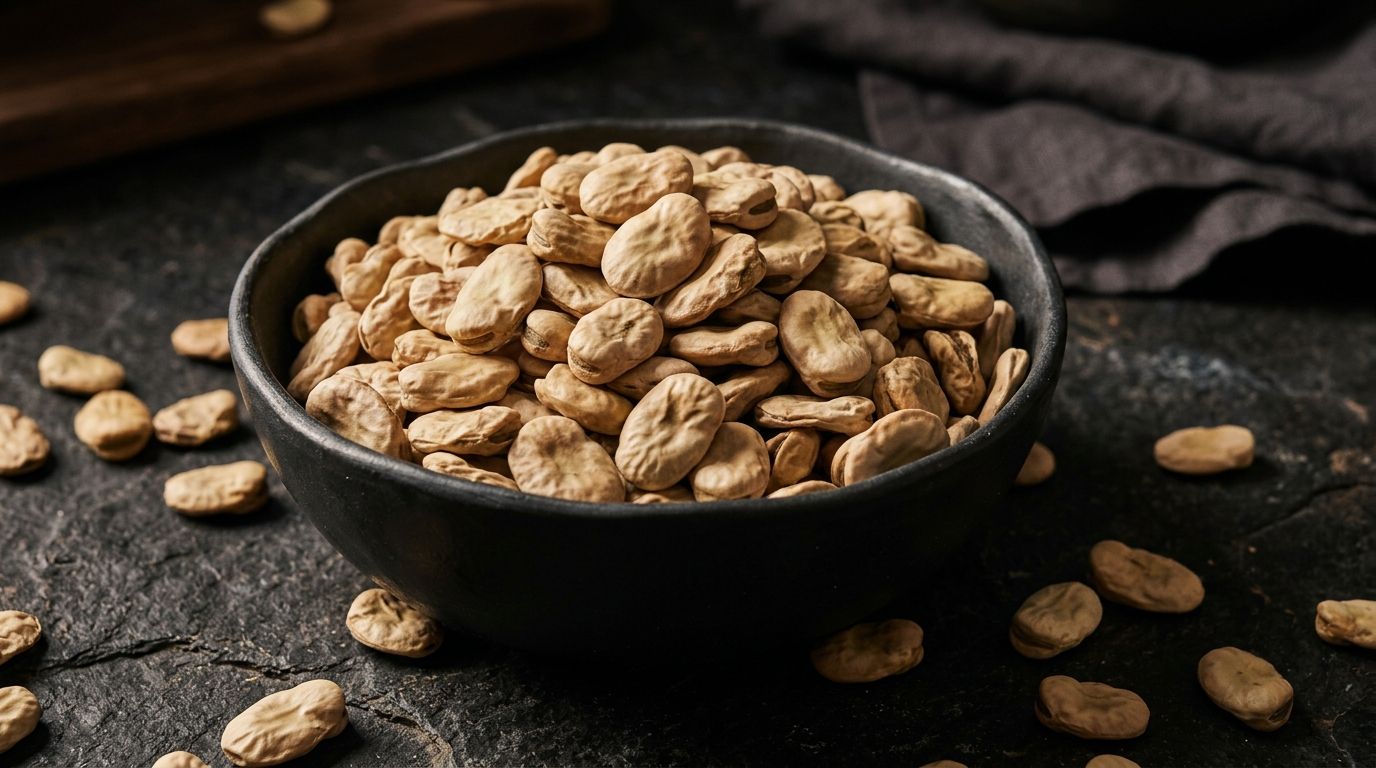
The fava has a hard outer skin (the pod) and a gray-green inner skin that wraps each grain. The inner skin contains most of the vicine and convicine, the components that endanger G6PD patients. Removing it lowers the risk and improves the flavor. The hulled and split version (Split Fava) is best known to the Arab market: it is the base of ful medames.
Dried fava: 2–3 years in proper conditions. Dry, cold, sealed. The problem: after a long year the fava skin hardens even further, and cooking time rises sharply. It is recommended to write a date on the fava bag. Dried hulled fava keeps better: less skin = less protection, but also faster cooking after storage.
Ful Medames, Disease and Cooking: The Fava in Cultures
Ful medames is probably the dish that has survived the longest without change. A recipe from Egypt 3,000 years ago, with garlic and lemon, is almost exactly identical to the one served today in Cairo, Baghdad and Beirut. No other food in the world can claim such a long unbroken sequence of preparation and continuous eating.
Hulled split fava, cooked to a creamy mash, served hot with olive oil, lemon juice, crushed garlic, cumin and parsley. The street version: in a large pot that cooks all night, served in a bowl with a hard-boiled egg and round bread. Cairo's restaurants open at three in the morning. Less than a couple of dollars for a full meal.
Fava cooked with garlic, cumin and olive oil, ground into a thick spread. In the Moroccan version: served with olive oil and hot paprika, eaten with bread. In the Egyptian version: thinner, like a soup. A popular, cheap and warming winter dish. Popular in the markets of Marrakech in the cold season.
Dried fava cooked with onion and olive oil to a full mash, served with shavings of raw fennel. An ancient dish known from Greek-Roman cuisine. In Sicily they add fresh cherry tomatoes and pangrattato (grated bread). On March 19, the feast of San Giuseppe, Macco di Fave is the traditional dish.
Fresh green fava sautéed with olive oil, garlic and thin slices of serrano ham. A classic spring dish in Andalusia and Catalonia. The recipe is simple: three minutes in oil, the ham goes in only at the end so it does not dry out. The contrast between the delicate bitterness of the fava and the saltiness of the ham is the reason the dish exists.
Ful medames survived 3,000 years with no essential change. Garlic, lemon, olive oil. No other food in the world can claim such a long sequence of the same preparation.
Global Market: China, Egypt, Ethiopia and the Growing Market
Global fava production reached 4.7 million tons a year, with three leading countries: China (38%), Ethiopia (16%) and Egypt (11%). The largest demand comes from the Arab world, where ful medames is a daily breakfast. Europe buys mainly fresh and frozen green fava for the gourmet market.
| Country | Annual production | Role |
|---|---|---|
| China | 1.8 million tons | Leading producer, mainly domestic consumption |
| Ethiopia | 750,000 tons | Producer + exporter to the Middle East |
| Egypt | 520,000 tons | Producer + importer for its large domestic market |
| Australia | 380,000 tons | Leading exporter to the Arab market |
| France | 120,000 tons | Premium for the European market |
| Israel | 15,000 tons | Seasonal local cultivation + imports |
Israel: The Local Fava Market
Israel has grown fava for hundreds of years. The fresh green fava reaches the markets from April and marks the spring. Hulled split fava is imported mainly from Australia and Ethiopia for the Arab-Israeli market and Middle Eastern restaurants. Price: $500–700 per ton for Canadian-Australian split fava. Fresh green fava: $800–1,200 per ton depending on season.
Blue Star supplies dried hulled split fava from Australia to the Israeli market. Minimum order: 20 tons. Packaging: 50 kg bags. Delivery time: 35–45 days CNF Ashdod. Suitable for the retail market and the food industry (soups, packaged ful medames).
Geography: Producing Countries and Production Chart
Fava grows mainly in the Mediterranean and northeast Africa regions. China is the largest exporter, but the quality of Australian fava is considered better for the Western market.
Favism: The Genetic Risk in Detail
G6PD deficiency is the most common enzymatic defect in the world: 400 million people. In Israel: Ashkenazim 0.5%, Sephardim 5–10%, North-African descent 10–25%, Arabs 8–20%. The gene is on the X chromosome, so men are affected more severely.
The mechanism of damage: the fava contains vicine and convicine. In the body they break down into compounds that produce free radicals. With a G6PD deficiency, the radicals damage the red blood cell membrane and cause hemolytic breakdown.
If you haven't tested for G6PD: ask a doctor, especially if you are of Mediterranean, Sephardic, African or Middle Eastern descent. The test: a blood count + G6PD enzyme activity. Simple and cheap. Worth knowing before adding fava to the menu.
| Ethnic group | G6PD prevalence |
|---|---|
| Ashkenazim | 0.5% |
| Sephardim | 5–10% |
| North-African descent | 10–25% |
| Arabs | 8–20% |
| Sub-Saharan African descent | 10–20% |
The Israeli Fava Market
Israel has traditionally grown fava for hundreds of years. Today: about 15,000 tons of local cultivation per year, mainly in the Galilee and the Jordan Valley. Fresh fava in the market from April is a strong signal of spring.
| Product | Israeli price | Season |
|---|---|---|
| Fresh green fava | ₪8–15 per kg | April–May |
| Dried whole fava | ₪8–14 per kg | Year-round |
| Hulled split fava | ₪12–18 per kg | Year-round |
Blue Star supplies dried hulled split fava from Australia. Minimum: 20 tons. Price $500–700/ton CNF Israel. Suitable for the retail market and the soup and ful medames industries.
Health: L-Dopa, Iron and Folate
Folate: 106% of the daily intake per 100 grams dry. Critical for pregnancy, gut bacteria and the prevention of birth defects. The fava is one of the best natural sources of folate.
A 2019 study tested 12 Parkinson's patients who ate 200g of cooked fava per day. A slight but measurable improvement in the UPDRS score after 3 weeks. The amount does not replace medication, but offers a mild supplement to treatment.
The Future of Fava: Climate and the 2030 Market
The fava's resilience to cold climates and its variety of nutritional uses make it a crop with potential. The growing trends: fava flour for gluten-free baking, fava protein for a market less controversial than soy, and fresh green fava in the gourmet market.
Climate trend: the fava grows in winter and spring, in conditions where wheat survives but warmth does not. As winter temperatures rise, the growing window narrows. Australia and Ethiopia will expand. The Mediterranean will contract.
The legume that killed people because of an ancient gene, that can ease Parkinson's, and that fed the pharaohs, is still not well enough known. That is about to change.
Interested in this product?
Send a message directly to Blue Star with the commodity details, and we'll get back to you within an hour during business hours.