Dried Papaya.
Carica papaya.
A fruit with no wild version. It was created, not found. And when the Spanish understood what they held, they changed its name and erased its history.
Botany and Origin of the Papaya Plant
Papaya, Carica papaya, is one of botany's great mysteries. Almost every fruit we eat today also exists in the wild. The apple has Malus sieversii in the mountains of Kazakhstan. The avocado has wild ancestors in Central America. The date has a wild form in Africa and the Middle East. The papaya does not. No science has managed to identify a wild ancestor from which the fruit sold in every market in the world came.
The meaning: the papaya we eat is a human creation. It was created by indigenous peoples in Central America, probably in southern Mexico or Guatemala, over thousands of years of deliberate selection. This is not the domestication of an existing fruit. It is the breeding of a new fruit. One of the rarest things in the history of agriculture.
Almost every fruit has a known origin. The papaya has no verified wild ancestor. It was not found, it was created.
When the Spanish arrived in America in the 16th century and found the fruit, they tried to give it a name. They called it papaya, and the origin of the word is disputed: some claim it comes from the Caribbean Taíno language, in which ababai is its name. Others point to versions in Maya and others. What is certain is that the original name, in whatever indigenous language it had, was erased. The Spanish gave it a new name, exported it to the world, and what had been local knowledge of thousands of years became a commercial product with a Spanish origin on its face.
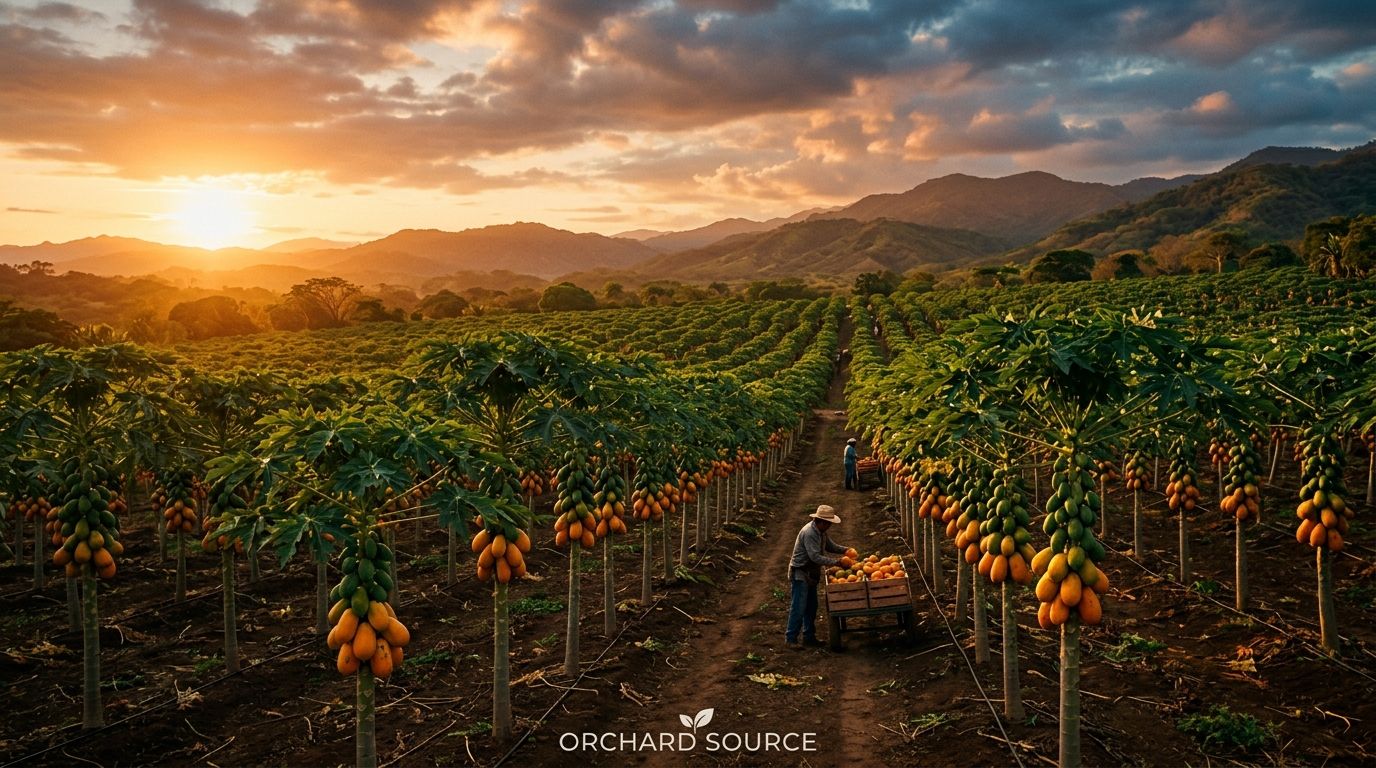
Papaya is not a true tree. Its trunk is made of soft green tissue, not wood. Botanically it is a giant herb that can reach 10 meters in height. This explains its crazy growth rate: a year from seed to first fruit.
Growing Regions: Malaysia, Thailand and Mexico
In 1519 Hernán Cortés arrives in Mexico. In 1526 a Spanish settlement is founded in Panama. By 1550 the fruit was already growing on both coasts of South America. By 1600 it had reached Europe, Africa, India and Malaysia. This is not the spread of a fruit. It is the spread of conquest. The Spanish and Portuguese took the papaya and pushed it into every region they ruled, before the world had a chance to understand what was happening.
One reason for the rapid spread was unique: papaya grows almost anywhere with heat and humidity. It does not require special soil, a rare climate, or a particular altitude. Throw a seed into warm, moist soil and within a year there is a tree and fruit. Spanish missionaries used it as a safe food source everywhere they went. Within a hundred years it became one of the most common fruits in all the tropics.
In Spanish: papaya. In Portuguese: mamão. In Hindi: papita. In Chinese: 木瓜 mùguā. In Swahili: papai. Everywhere a different name. But the original name, in the Taíno language spoken by people who no longer exist, was completely forgotten.
By the 20th century India became the world's largest producer, with over 6 million tons a year. A fruit created in Mexico, spread by the Spanish, and grown today mainly in India and Brazil. This is globalization before it had a name.
Biochemistry: Papain and Carotenoids in Dried Papaya
Inside the green papaya, before it ripens, there is a white milk. Caribbean peoples knew about this fluid thousands of years before science understood what it was. They wrapped tough meat in green papaya leaves and found it more tender the next day. They rubbed the skin with the fluid from the trunk and found wounds healed faster. They ate papaya after heavy meals and felt everything digested easily. This is not folklore. It is biochemistry.
In 1879 science first isolated the responsible component: papain, a cysteine protease that breaks peptide bonds in proteins. Since then, whole industries were built on it. The meat industry uses papain for industrial tenderizing of tough cuts. The beer industry uses it to prevent haze. The textile industry uses it to process wool. The cosmetics industry puts it into face creams and masks. The medical industry studies anti-inflammatory uses.
Caribbean peoples knew how to tenderize meat with papaya leaves thousands of years before science understood why. They did not know what papain was. They knew it worked.
Papain is concentrated mainly in green papaya and in the seeds. During drying, some of the enzymatic activity is destroyed by heat. But even in the dried fruit, traces of active papain are present. This is one reason dried papaya is relatively easy to digest compared to other dried fruits.
The Seeds, the Thing Everyone Throws Away
Black papaya seeds have a sharp, peppery flavor and a higher papain content than the fruit itself. In some Asian and African cuisines they are used as a substitute for pepper. Preliminary studies have examined anti-parasitic properties. In most drying plants, the seeds are thrown away. That is probably a mistake.
Nutritional Values and Health Benefits
Fresh papaya is 88% water. Dried papaya is 14 to 20% water. Every kilogram of finished product starts with about 6 to 7 kilograms of fresh fruit. This is not just an economic calculation. It also explains why the flavor is so concentrated, and why the color is so deep. Drying is not the removal of water. It is the compression of everything that was in the fruit into a small, portable form.
In parts of Thailand and India, they still dry in the sun. Low cost, a deeper flavor according to some producers, but less control over moisture and outcome. Industrial drying is more consistent and allows rigorous quality control. Most of the commercial volume comes from drying ovens.
Growing, Harvesting and Drying the Papaya
From the outside, papaya looks simple: a large green-yellow fruit. But within the single species Carica papaya opens a world of varieties with extreme differences in size, flesh color, sugar content, and drying quality. What the consumer sees on the shelf as "dried papaya" may come from a fruit that looks completely different from the variety next to it.
The most common commercial variety for drying. A very large fruit, 2 to 5 kilograms. Deep orange-red flesh, very sweet, a high sugar content suited to the sweetened version. A high yield per dunam, durable to handling. A Cuban development from the 1950s that conquered Latin America.
A small fruit, 400 to 700 grams. Yellow-orange flesh, sweet and delicate. Developed in Hawaii in the 1970s and from there spread to Thailand and Brazil. Preferred for the fresh market because of its convenient size for the consumer, but a high solids-to-water ratio allows premium drying with less shrinkage.
A commercial hybrid developed by a Taiwanese company in 1990. Disease-resistant, high-yielding, uniform orange-red flesh. Very common in Vietnam and Thailand today. Its color uniformity after drying is exceptional. Most dried papaya from Thailand today is Red Lady.
Papaya is not a classic seasonal crop. A tree continues to bear almost year-round in suitable climate conditions. Production peaks in Latin America: July–November. In Southeast Asia: March–June. This is one of its great commercial advantages, a continuous supply with no sharp seasonality.
Processing: Slices, Cubes and Sweetened Papaya
When you dry papaya, you remove the water and leave everything else. The vitamins, minerals, sugars, fiber. 100 grams of fresh papaya has 43 calories. 100 grams of dried papaya, with no added sugar, has about 250 calories. But also vitamin C, which concentrates from a level of 62 mg in fresh fruit to about 20 to 40 mg even after drying, unlike other fruits that lose most of their vitamin C in the process. Papaya holds onto some of it.
Beta-Carotene, What Gives the Color
The orange color of papaya is beta-carotene, a vitamin A precursor. The more orange the fruit, the higher the beta-carotene concentration. In the drying process, the color intensifies because the water leaves and the pigment concentrates. Dried papaya that looks pale-yellow is usually either a different variety, harvested unripe, or underwent drying that damaged the pigment.
Papaya contains chitinase, an enzyme structurally similar to latex proteins. About 30 to 50% of people with a latex allergy may develop a cross-reaction to papaya. Symptoms: itching in the mouth, lip swelling, up to an anaphylactic reaction in extreme cases. Contact with the fluid of green papaya is more dangerous than eating ripe fruit.
Leading Papaya Varieties for Commercial Drying
When you buy dried papaya, the first question not always asked is: does it have added sugar? The answer changes almost everything. Natural dried papaya is fruit in a compressed form. Sweetened papaya is a candy that once came from a tree.
Dried directly, without sugar soaking. A deep golden-orange color, a chewy and still slightly resistant texture. A fruity flavor with light acidity. Moisture 14 to 18%. Rare in the market and more expensive. Sugar content: 30 to 40 grams per 100 grams, all natural from the fruit. A shorter shelf life.
The fruit is soaked in a sugar solution before drying. The sugar penetrates the tissue, replaces some of the water and allows more uniform drying and a longer shelf life. The flavor is very sweet, the color intense and darker due to the Maillard reaction. Sugar content: 55 to 70 grams per 100 grams, some added. Moisture 18 to 22%.
Some producers add the artificial color INS 110 (Sunset Yellow) to shape the orange. The color is approved in many standards but raises concerns in some studies. Under EU regulations, the label must state: "may have an adverse effect on activity and attention in children." A simple test: a papaya with too uniform an intense orange, be suspicious.
Size Grades and Quality Standards for Papaya
Dried papaya is harder to inspect visually than a Brazil nut, which you can cut and immediately see if it is good. With dried fruit, most of the signs are subtler, and only some are visible to the eye without equipment. But there are a few things that cannot be hidden.
Color
Quality natural dried papaya: deep golden-orange, not completely uniform. Quality sweetened papaya: deep orange with a light brown tone. Warning lights: extreme paleness (harvested unripe, over-drying), too uniform a neon orange (artificial color), dark brown spots around the edges (excessive Maillard, drying at too high heat), grayness (early mold).
Texture
Flexible, chewy, not breaking under light pressure. Papaya too dry that breaks easily: over-dried, or old. Sticky papaya that rolls into a clump: packed at too-high moisture, a mold risk. Papaya that leaves oil on the fingers: normal, natural fat from the fruit.
Smell
Dried papaya should smell sweet-fruity, with a tropical tone. A sour smell: oxidation. A moldy smell: high moisture at an intermediate station. A sharp chemical smell: excess SO₂, usually dissipates on opening but indicates aggressive use of chemicals.
SO₂ is a preservative that prevents oxidation and preserves color. Permitted up to 2,000 ppm under EU regulations. In people sensitive to sulfites, about 1% of the population and mainly asthmatics, SO₂ can cause bronchospasm, headache and skin reactions. Labeling is mandatory if SO₂ ≥ 10 ppm.
Global Dried Papaya Market Trends 2026
Dried fruit looks as if it can sit in the cupboard forever. This is an illusion. Microbiological and physico-chemical processes do not stop, they only slow down. Under wrong storage conditions, dried papaya can become inedible within weeks. Under the right conditions, it lasts 12 to 18 months without losing anything significant.
| Condition | Proper storage | What happens when not |
|---|---|---|
| Temperature | 15–20°C | Above 25°C: accelerated oxidation, color and flavor change |
| Relative humidity | below 60% | Above 65%: moisture absorption, crystallization, mold risk |
| Light | darkness | Direct exposure: beta-carotene breakdown, fading |
| After opening | Airtight container + refrigerator | Air exposure: accelerated oxidation, odor absorption |
Sweetened papaya is more durable than natural because of the high sugar content that functions as a natural preservative. This is the one advantage where the sweetened version beats the natural in terms of logistics.
A fruit that traveled 30 days from Thailand inside a container, entered a warehouse, went out to a shop, and you bought it, can still be excellent. But only if every station did its job.
Summary and Dried Papaya Importing Services by Blue Star
Dried papaya is one of the cheapest commodities in the dried-fruit market. It does not enjoy the prestige of goji, the premium price of Medjool dates, or the dramatic botanical identity of the Brazil nut. It is sold in plastic bags in supermarkets, usually in the sweetened version, usually with little information on origin or variety.
But behind the simple orange snack is a fruit created by humans, spread by conquerors, carrying an enzyme the meat industry turned into a billion-dollar business, and found today in every tropical corner of the world. It does not get a story told about it. That is not because there is nothing to tell.
Purchase Guide
To buy: check the smell first of all. Sweet-fruity: good. Sour or chemical: put it back on the shelf. Check texture: flexible and chewy, not brittle and not sticky. Check color: deep orange, not neon, not pale. Read ingredients: SO₂ and INS 110 are legitimate but know they are there. Prefer the version with no added sugar if you want the real flavor of the fruit.
| Criterion | Good | Bad |
|---|---|---|
| Color | Deep golden-orange, not completely uniform | Neon, gray spots, paleness |
| Texture | Flexible, chewy | Brittle, sticky, clumped |
| Smell | Sweet, tropical, fruity | Sour, moldy, chemical |
| Flavor | Concentrated, sweet with depth | Flat, too sweet without fruit, bitter |
| Label | Country of origin, production date, clear ingredients | Missing information, old date |
Interested in this product?
Send a message directly to Blue Star with the commodity details, and we'll get back to you within an hour during business hours.