Freekeh
Green wheat roasted over an open fire. The smoky flavor no other grain holds. A Palestinian-Levantine tradition that reached the chef's table.
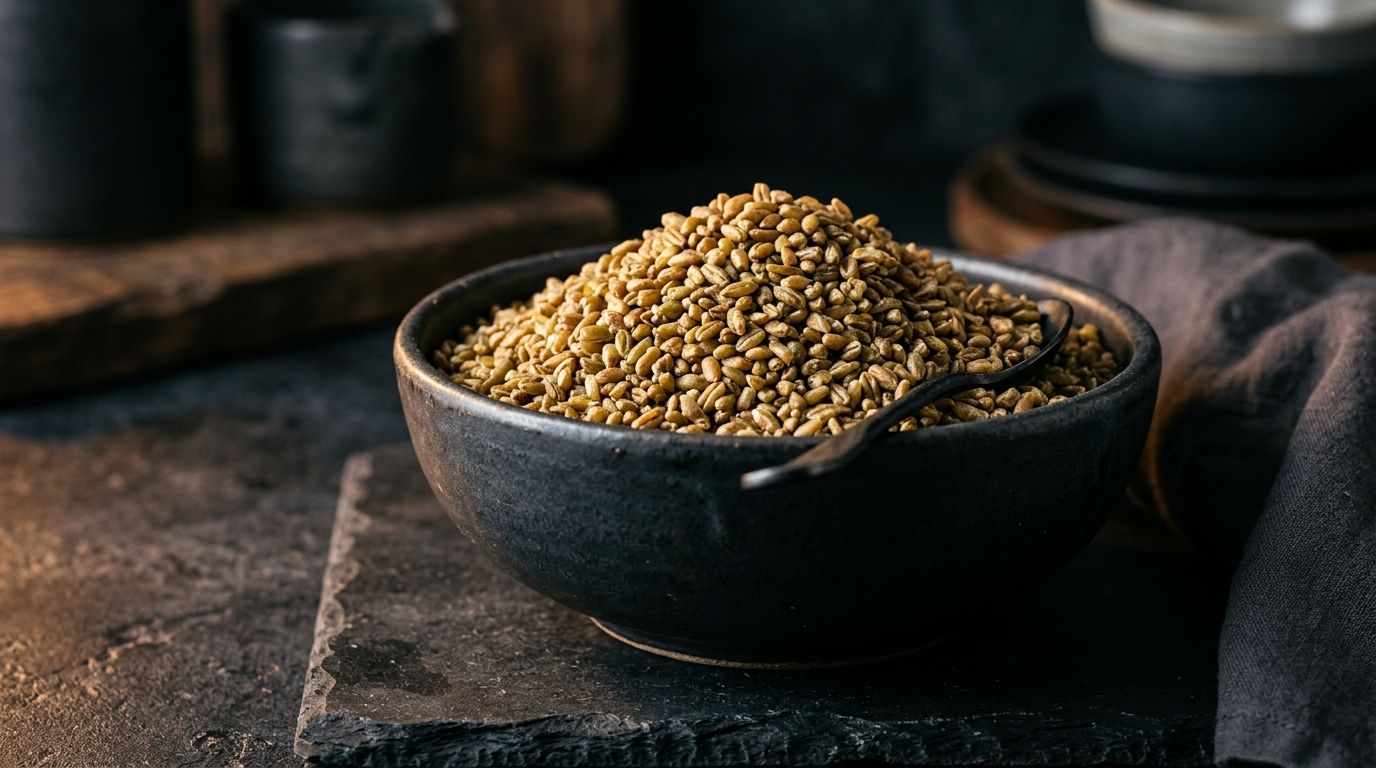
The legend of fire: how freekeh was born
Legend has it that freekeh was born by accident, about 2,000 years ago, when a village was attacked and its wheat fields burned before full ripening. The villagers, standing in despair, rubbed the scorched grains in their hands and discovered they were tasty and fragrant. Freekeh in Arabic means "that which was rubbed."
Legend aside, freekeh is a phenomenon unique to Levantine agriculture: harvesting partially-ripe durum wheat, roasting it over an open flame, and rubbing it by hand to remove the straw and chaff. The result: a greenish grain with a smoky-nutty flavor that has no equivalent. Stored this way, the grain kept for many months — a huge advantage for the Levantine farmer.
Freekeh is made exclusively from green durum wheat. Open-fire roasting dries and chars the straw but leaves the grain inside the sheaf intact. The fire's smoke penetrates and leaves an aromatic signature that cannot be imitated by industrial drying.
Whole vs cracked: two different freekehs
The market has two main forms of freekeh, each requiring a completely different cooking approach. Whole freekeh is the grain as-is, with a grainy, chewy texture that requires 40-50 minutes of cooking. Cracked freekeh is grains broken into two or three pieces, cooks in 20-25 minutes, and is better suited to pilaf and mujaddara.
Freekeh is rich in lutein and zeaxanthin, two carotenoids essential to eye health that are rare in grains. Studies indicate a link between their regular consumption and a reduced risk of macular degeneration.
Geography: the homeland of freekeh
Freekeh is produced in a relatively limited area: Syria, Palestine, Jordan, Lebanon, Israel (the Golan region), and southern Turkey. Algeria, Tunisia, and Egypt produce small quantities. Over the past decade Australia has become one of the leading suppliers, as large grain farms adopted the crop for export.
Before 2011, Syria was the leading exporter of freekeh. The war destroyed much of the agricultural infrastructure. Australia filled the gap and is today a reliable supplier to Western markets.
Levantine culinary tradition
Chicken cooked with spices (baharat, cumin, allspice) over whole freekeh, served with pine nuts and almonds toasted in butter. It's a combination that appears at every wedding, in holiday meals, and in Lebanese restaurants from time immemorial through Beirut. The aroma of the freekeh with the spices and butter is one of the most recognizable smells of Lebanese cuisine.
Cracked freekeh with bone broth, onion, tomatoes, and cumin. Served hot with round bread. The Palestinian version adds fresh lemon. The thickness of the freekeh within the soup creates a unique texture, somewhere between soup and stew. A simple dish that shows why freekeh served as a traditional winter food.
Cooked and cooled freekeh, with cherry tomatoes, cucumber, red onion, herbs, and a lemon-olive oil dressing. The modern version has replaced freekeh in quinoa salads across Europe. It has one advantage: a smoky flavor quinoa cannot provide.
Wheat that burned before reaching full ripeness — and precisely because of that, its flavor is deeper than any other grain.
Production process: from field to sack
Traditional freekeh production is labor-intensive work that limits industrial production. The wheat is hand-harvested at the green stage, about 3-4 weeks before the regular harvest. Each field is harvested within a narrow window of a few days. Harvest too early: grains too small. Too late: loss of the green color and roasting quality.
- Early harvest: partially-ripe durum wheat, greenish-yellow, 35-40% moisture
- Field drying: the sheaves are laid in the sun for 1-3 days
- Roasting: the sheaves are roasted over an open fire, the straw burns, the grain partially cooks
- Threshing and rubbing: manual (traditional) or mechanical, separating grain from straw and burnt bran
- Cleaning: sorting, removing damaged grains, drying to 10-12% moisture
- Cracking: for cracked freekeh, breaking into 2-3 mm segments
Industrial production (Australia, Algeria) uses harvesters and oven roasting. The smoky flavor is less intense. Traditional open-fire freekeh (Syria, Lebanon) sells at a 40-60% premium — "artisan freekeh" for the European gourmet market.
Nutrition deep-dive: prebiotic fiber and lutein
| Component | per 100g dry | vs white rice |
|---|---|---|
| Protein | 12g | 2.5x |
| Dietary fiber | 8g | 4x |
| Iron | 3.6mg | 3x |
| Zinc | 3.5mg | 2x |
| Magnesium | 100mg | 3x |
| Lutein + zeaxanthin | very high | unique to green wheat |
Lutein and zeaxanthin are carotenoids found in high concentration in green wheat, and after roasting their concentration decreases. This is why traditional freekeh is considered a unique nutritional matter: it provides carotenoids that most wheat eaters don't get.
Freekeh fiber contains fructooligosaccharides (FOS), prebiotic fibers that serve as a substrate for friendly gut bacteria. Early studies indicate an improvement in the gut bacterial profile with regular consumption.
Freekeh in Israel: from Arab kitchen to the chef's table
In Israel, freekeh was for decades a product found in Arab markets — in grocery stores in Rahat, Sakhnin, and Nazareth. The Arab-Israeli public grew it and ate it as a tradition. Then, in the 2010s, something happened: Israeli chefs "discovered" it.
Today freekeh is served at leading restaurants. It appears in salads, as a side to fish, as a base for Israeli-style risotto. Retail price: ₪18-28 per 500g (cracked), ₪24-35 (whole). Organic: 40-50% more.
Kibbutzim and farms in the Golan grew traditional freekeh before it became a trend. "Golan freekeh" is sold as a local brand in health stores. Golan cultivation: local durum wheat, partial manual roasting.
Global market: a new superfood
The global freekeh market reached $280 million in 2023, with annual growth of 12-15%. Before 2010, freekeh was almost unknown outside the Levant. What changed: superfood articles in publications like TIME and Bon Appétit pinned the title "the next quinoa" on freekeh.
| Freekeh | price per ton | preferred source |
|---|---|---|
| Whole, conventional | $800-1,100 | Australia, Algeria |
| Whole, organic | $1,300-1,800 | Australia, Jordan |
| Cracked, conventional | $700-950 | Australia |
| Traditional fire (artisan) | $1,800-2,500 | Syria, Lebanon |
Cooking: how to cook freekeh correctly
- Rinse: rinse well before cooking, removing dust and residual straw fibers
- Water ratio for whole freekeh: 1:2.5 (cup of freekeh = 2.5 cups water)
- Water ratio for cracked freekeh: 1:2
- Cooking time, whole: 40-50 minutes over medium heat
- Cooking time, cracked: 20-25 minutes
- Aromatics: add baharat, cumin, and allspice for traditional cooking
- Rest: 10 minutes covered after cooking, completing water absorption
For freekeh with an even deeper smoky flavor: sauté for a minute in 2 tablespoons of butter before adding the water. The brief sauté heats the oils and releases aromas. That's the difference between home freekeh and restaurant freekeh.
Future: from niche grain to global grain
Freekeh stands at a turning point. It is no longer an "exotic Middle Eastern product" — it's in Whole Foods, in Waitrose, and in major European supermarkets. Global demand is rising, and the Australians increased production areas by 200% over the past decade.
The risk: over-commercialization that erases the uniqueness of the roasting. "Industrial" freekeh made in an oven is not the same as freekeh over an open fire. When you have to choose, look for "wood-fired" or "traditional flame-roasted" on the packaging.
Blue Star supplies cracked and whole freekeh to the Israeli market from Australian sources. Minimum order: 10 tons. CNF Israel price: $750-1,000/ton depending on season and availability.
Interested in this product?
Send a message directly to Blue Star with the commodity details, and we'll get back to you within an hour during business hours.