Buckwheat
A gluten-free pseudo-cereal from Central Asia. From Russian kasha to Japanese soba noodles, by way of green fields that bloom in three weeks.
Botany and origin of the buckwheat plant
Buckwheat (Fagopyrum esculentum) is not related to wheat, oats, rice, or any other cereal. It is a category of its own — a pseudo-cereal, a flowering plant of the knotweed family (Polygonaceae), a relative of sorrel and rhubarb. Its grain-like seeds are actually a small, three-sided triangular fruit.
Its origin: Central Asia, probably the Yunnan region of southwest China or the southern slopes of the Himalayas. From there buckwheat spread in every direction — into Japan, into Siberia and Russia, and into Europe along the Sino-Russian caravan routes. Its Russian name, грека (Greka), means "of Greece" — ironic, because it reached Russia via Byzantine Greece, not from Greece itself.
In Russian culture, kasha — boiled roasted buckwheat — is a deep national food. In Japan, soba (蕎麦) literally means "buckwheat." From the Siberian farmer to the sushi restaurants of Yokohama, the same little plant that crossed the mountains 4,000 years ago.
Buckwheat is completely gluten-free, though it is sometimes processed in facilities that also handle wheat. For celiac sufferers, it's important to look for a dedicated gluten-free certification on the packaging.
Growing regions: Russia, China and Kazakhstan
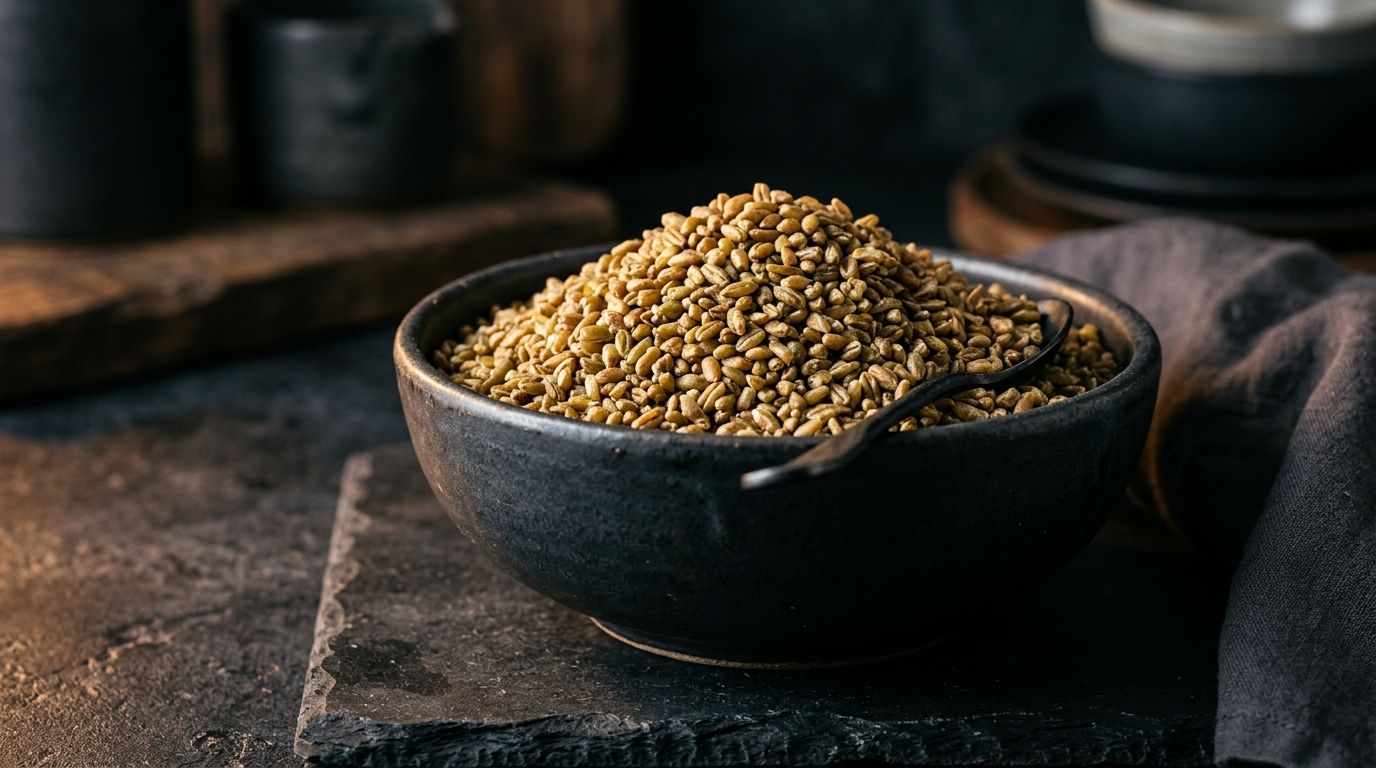
The wonder of buckwheat is that its two different treatments taste entirely different. Green (raw) buckwheat is the unprocessed groat, light-green in color — a delicate, slightly nutty flavor, suited to sprouting and milling into fine flour. Roasted buckwheat (kasha), maroon-brown, has undergone high-heat roasting that completely changes its chemical profile and produces a deep, smoky, complex-nutty flavor.
Buckwheat protein is relatively high quality for a plant protein: it contains all the essential amino acids, including lysine — an amino acid absent from most grains. This makes it an important addition to a plant-based diet.
Rutin, the secret flavonoid
Buckwheat contains a high concentration of rutin, a flavonoid with anti-inflammatory and capillary-strengthening properties. Studies indicate a positive effect on lowering blood pressure and strengthening capillaries. Green buckwheat contains more rutin than roasted, because roasting breaks down some of the flavonoids.
Biochemistry, rutin, complete and gluten-free protein
Buckwheat grows well in conditions most cereals don't survive: acidic, poor soil, cold temperatures, and irregular rainfall. This makes it a strategic crop in regions like Siberia, the mountains of Poland, and the mountainous provinces of China. It also reaches maturity in just 70-90 days — the fastest grain in the world.
After Russia's invasion of Ukraine, buckwheat exports from Russia were hit by sanctions. Prices rose 40% over the past two years. European buyers turned to Poland and Canada as an alternative.
Nutritional values and health benefits
If there's one dish that defines Russian cuisine more than anything else, it's kasha. Not borscht, not pirozhki — roasted buckwheat. Every Russian child grows up with the specific smell of roasted buckwheat cooking on the stove, with butter and sometimes onion. It is a food of childhood, comfort, and memory.
Roasted buckwheat boiled at a 1:2 ratio with water until fully absorbed. Finished with butter and salt. Variations: with fried onion, with mushrooms, with gribenes (goose fat). Served as a side to meat or egg, or alone as breakfast. In the Soviet army, kasha was the standard dish three times a day.
Soba noodles made from buckwheat flour (sometimes with added wheat flour). Eaten cold (Zaru Soba) with a dashi broth for dipping, or hot (Kake Soba) in soup. In Tokyo there are soba artisans who devote their lives to milling the right flour and rolling the noodles. Nihachi Soba — 80% buckwheat, 20% wheat — is considered the premium.
In Brittany, France, buckwheat is called sarrasin (Moorish). A galette is a savory crêpe of buckwheat flour, served filled with cheese, egg, and more. The galette was the peasant food of Brittany before it spread to the upscale Parisian café. Today it's a tourist dish, but with real roots.
From Russia to Japan, from Poland to France. One plant that knew no borders — originating in Central Asia and ending up as an art on every continent.
Growing, harvesting and drying buckwheat
Buckwheat processing begins with harvesting the groats, which — unlike wheat — grow as a small triangle with a hard hull that must be removed. Hulling causes partial loss of the bran layer. A hulled groat is the green groat, ready for cooking, milling, or roasting.
Processing stages
- Harvest: 70-90 days from sowing. Manual or mechanical harvesting depending on field size
- Drying: to 14% moisture before storage. Critical: above 16% = rapid mold development
- Hulling: removing the hard hull. Yields a light-green groat
- Roasting: 150-180°C for 15-20 minutes. Turns green into roasted-brown (kasha)
- Milling: into fine (Light) or medium (Medium) flour for baking
Whole buckwheat flour contains the bran and germ. Whiter = less fiber and deep flavor. Darker = more nutrition and strong flavor. For French galettes and Japanese soba: medium flour. For pancakes: light flour.
Processing: whole groats, flour and grits
Sprouting green buckwheat is a phenomenon revived in the health market. A sprouted groat contains a 2-3x higher concentration of antioxidants, and far higher rutin levels than the regular groat. The sprouting process breaks down anti-nutrients (phytic acid) that interfere with mineral absorption.
Buckwheat sprouted for 2-3 days is ready to eat. It can be eaten as-is in salads, dried and milled into sprouted flour, or added to granola. The raw-food industry adopted it as a base for "living" snacks — sprouted flour dried at low temperature (below 42°C) to preserve enzymes.
Green unhulled: a year or more. Green hulled: 6-8 months. Roasted (kasha): 4-6 months. Flour: 3-4 months. A solvent-like smell = oxidized oils, do not eat.
Leading varieties and countries of origin
Buckwheat is relatively thoroughly researched compared to other minor grains, due to its prevalence in Russia and East Asia. The research points to several areas of interest: the effect of rutin on blood pressure, diabetes management, and protein quality.
| Component | Amount per 100g | % RDI | Note |
|---|---|---|---|
| Protein | 13.3g | 27% | includes lysine |
| Magnesium | 231mg | 55% | very high for a grain |
| Phosphorus | 347mg | 50% | bone health |
| Copper | 1.1mg | 122% | above upper RDI |
| Manganese | 1.3mg | 57% | antioxidant |
| Vitamin B6 | 0.21mg | 16% | metabolism |
A study published in the Journal of Nutrition (2022) found that daily buckwheat consumption lowered post-meal blood sugar by 12-19% in type-2 diabetics versus a control group. Rutin and D-chiro-inositol are considered responsible.
Size grades and quality standards for buckwheat
The global buckwheat market — an unknown niche before 2010 — crossed the $1 billion mark in 2023 and expects annual growth of 8-11% through 2030. The drivers: the gluten-free revolution, growing interest in ancient grains, and the raw-food trend.
The Japanese soba market alone: $800 million a year. Russia consumes 800,000 tons of buckwheat a year, more than any other country. Poland, the largest exporter to Western Europe, doubled its exports over the past decade.
Organic green buckwheat: $700-1,100/ton. Roasted (kasha): $800-1,200/ton. Buckwheat flour: $900-1,400/ton. Organic premium: 30-50% over conventional.
Global buckwheat market trends 2026
Israel imports about 3,000-5,000 tons of buckwheat a year, mainly from Poland and Ukraine (with disruptions from the war). The demand: the health market, gluten-free communities, and a Russian-speaking community that has eaten kasha since infancy.
Israeli health stores offer green, roasted, flour, and sprouted buckwheat. Supermarkets introduced roasted buckwheat in 400-500g packs. Retail prices: ₪12-18 per 400g. Demand for organic grew 20% in the past year.
Blue Star supplies green and roasted buckwheat to the Israeli market from Poland and Ukraine sources. Minimum order 10 tons. Green price: $750-950/ton CNF Israel.
Summary and Blue Star buckwheat import services
Buckwheat sits at the intersection of several global trends that favor it. Climate change? Buckwheat is more resistant to heat and irregular rainfall than wheat. Gluten-free? Buckwheat is one of the few crops that provide a "grain feel" without gluten. Agroecology? Buckwheat improves the soil and attracts bees for pollination, which has made it a preferred crop in organic farming.
Japan is developing soba varieties with double the rutin concentration. Russia is investing in expanding exports. Canada is increasing growing areas. By 2030, buckwheat is expected to no longer be a niche — it will be a central crop in gluten-free agriculture.
| Use | Description | Target market |
|---|---|---|
| Kasha (roasted) | Traditional dish, side | Russia, Israel, Poland |
| Soba noodles | Japan, Asia, global | Japan, global gourmet |
| Baking flour | Galettes, pancakes, bread | Europe, Israel, France |
| Granola & sprouted | Raw health market | Israel, USA |
| Pasta | Gluten-free alternative | Europe, Israel |
Interested in this product?
Send a message directly to Blue Star with the commodity details, and we'll get back to you within an hour during business hours.